
AI Brand Strategy
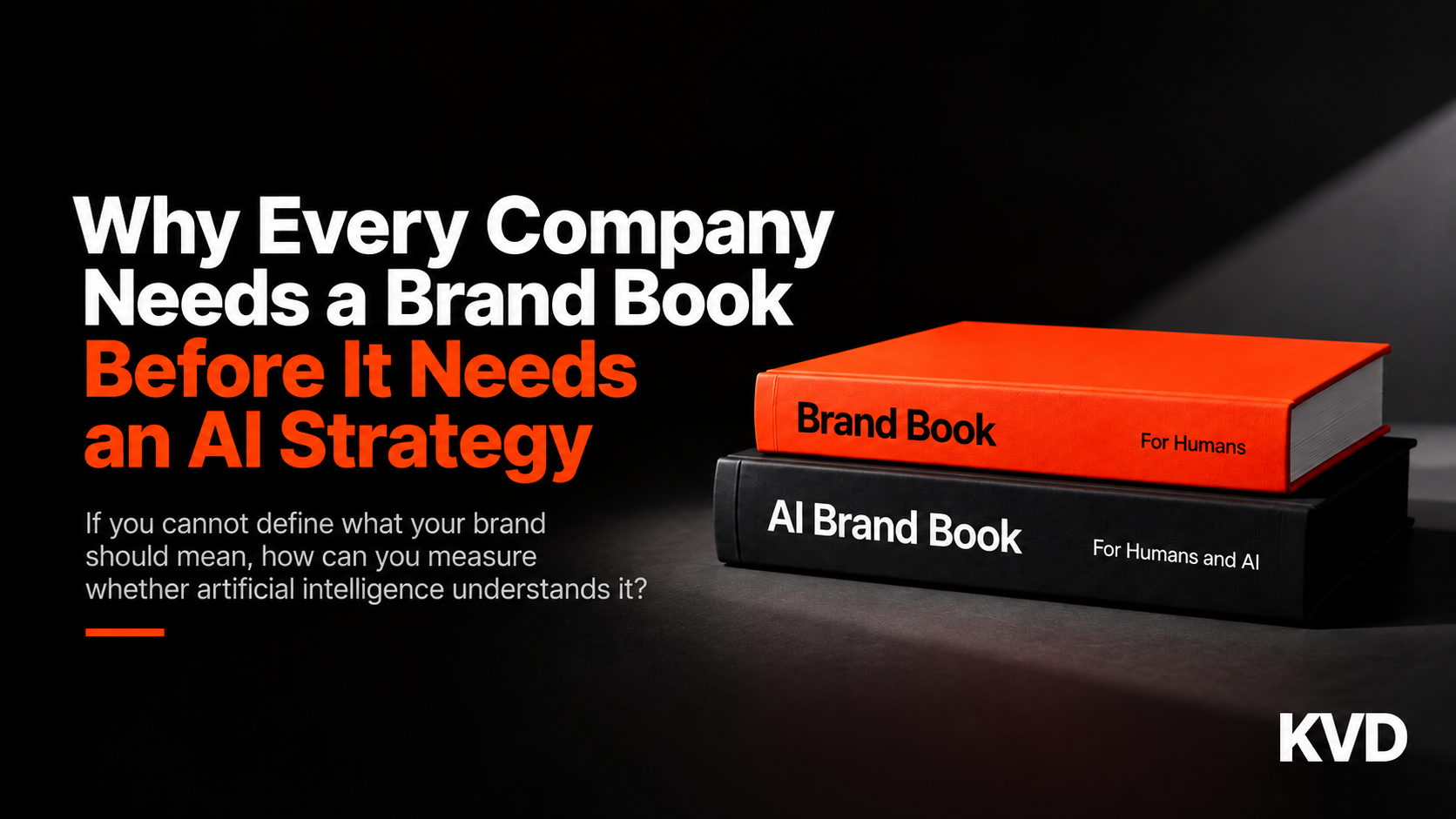
Why Every Company Needs a Brand Book Before It Needs an AI Strategy
If you cannot define what your brand should mean, how can you measure whether artificial intelligence understands it?
By KVD · Published October 2026
Companies are investing considerable resources in artificial intelligence. Marketing departments are experimenting with AI-generated content, AI-powered search, automated customer experiences, and new approaches to digital visibility. Yet amid this enthusiasm, a fundamental question is frequently overlooked.
Does your company have a clear, documented understanding of what its brand is supposed to represent? For decades, the Brand Book has served as the strategic reference point for corporate identity, positioning, differentiation, and communication. It establishes what a company stands for, how it wants to be perceived, and what distinguishes it from competitors.
But as artificial intelligence increasingly influences how organizations are discovered, interpreted, compared, and recommended, the importance of that foundation is changing. Before companies can manage how AI understands their brands, they must establish precisely what AI should understand. And that begins with the Brand Book.
The Brand Book Is a Strategic Compass
Mention a Brand Book, and many executives immediately think of logos, typography, corporate colors, and guidelines for visual consistency. These elements matter. But reducing a Brand Book to a design manual overlooks its strategic purpose.
A comprehensive Brand Book defines the intended meaning of an organization. It establishes the company's identity, market positioning, value proposition, differentiation, brand architecture, personality and values, and communication principles. More importantly, it creates a shared understanding of what the organization wants to represent to its audiences.
Consider a technology company that describes itself as an enterprise AI platform. What does that actually mean? Which market category does it compete in?
What capabilities distinguish it from traditional software providers? Which customer problems does it solve? Who are its genuine competitors?
What associations does it want customers, investors, and partners to make? Without clear answers, the positioning remains little more than an ambition. A Brand Book turns that ambition into a strategic reference.
And in an AI-mediated marketplace, that reference becomes essential.
You Cannot Measure a Gap Without Defining the Intended Position
At KVD, we define the AI Brand Gap™ as the measurable difference between a company's Intended Brand Understanding and how AI systems understand, associate, compare, and recommend that company. The concept introduces an important methodological requirement. Before evaluating whether AI understands a company correctly, the organization must define what correct understanding actually means.
Imagine asking ChatGPT, Gemini, or Claude to describe your business. One system identifies you as a technology consultancy. Another describes you as a software developer.
A third categorizes you as an AI solutions provider. Which interpretation is correct? Without an independently established brand positioning, the answer becomes subjective.
A marketing director might prefer one description. The CEO might favor another. The sales organization may use entirely different terminology.
The problem is no longer limited to artificial intelligence. It is a lack of strategic clarity within the organization itself. You cannot identify an AI Brand Gap until you establish and know your Intended Brand Understanding.
This is why the Brand Book is not merely a communications asset. It is the foundation against which AI-mediated brand interpretation can be assessed.
Intended Brand Understanding: The Strategic Reference Point
Traditional brand management has always concerned itself with perception. Companies develop positioning strategies, communicate distinctive advantages, and attempt to influence how audiences understand their businesses. Artificial intelligence introduces another interpreter into that process.
At KVD, we use the term Intended Brand Understanding to describe the identity, category, differentiation, capabilities, and associations an organization wants relevant audiences and AI systems to recognize. This includes several fundamental questions. What is the company?
Which business category should it be associated with? What capabilities and services should it be known for? What differentiates it from competitors?
Which strategic topics and customer needs should be associated with its name? And which companies should AI consider its relevant competitors? These questions may appear straightforward.
In practice, organizations often struggle to answer them consistently. Corporate strategies evolve. New services are introduced.
Acquisitions expand capabilities. Business models change. Marketing messages accumulate across departments and markets.
Over time, the intended identity of the organization can become fragmented. The Brand Book provides an opportunity to establish coherence. Not by simplifying the company beyond recognition, but by defining a clear strategic position that can be communicated consistently across channels, audiences, and information environments.
When the Company Changes but Its Brand Understanding Does Not
One of the greatest challenges in modern brand management is the speed at which companies evolve. An organization may reposition itself from a product manufacturer into a technology solutions provider. A software business may become a broader enterprise platform.
A consultancy may expand into data, automation, and AI transformation. Internally, these changes can happen relatively quickly. Externally, established associations may persist for years.
Historical media coverage, industry classifications, third-party references, and product descriptions continue influencing how the organization is understood. KVD refers to this persistence as Brand Gravity. The stronger the historical association, the more difficult it may be for a new strategic identity to become established.
Artificial intelligence can reflect this tension. An AI system may accurately describe a company's historical business while overlooking its current direction. It may recognize established products but fail to associate the organization with newer capabilities.
Or it may recommend the company within its former category rather than the market it now intends to serve. This is precisely where a clearly defined Brand Book becomes strategically valuable. It establishes the intended position independently of the historical information environment.
Without that reference, companies risk confusing familiar brand associations with strategically appropriate ones.
From Brand Book to AI Brand Book
A traditional Brand Book establishes how an organization intends to present and communicate its brand. But AI systems do not interpret brands in precisely the same way as human audiences. They synthesize information from multiple sources, identify relationships between companies and categories, and generate descriptions and recommendations based on the information available to them.
This creates a need to translate traditional brand strategy into a more structured definition of how the organization should be understood in AI-mediated environments. At KVD, we call this the AI Brand Book. The AI Brand Book builds on the traditional Brand Book by explicitly defining the company's intended identity, category, capabilities, differentiation, strategic associations, competitive context, and relevant use cases.
It provides a reference for evaluating how AI systems currently interpret the organization. Importantly, an AI Brand Book is not a set of instructions that AI platforms are guaranteed to follow. It is a strategic management instrument that helps companies define, communicate, and assess their intended positioning across an increasingly complex information environment.
The distinction matters. A Brand Book establishes what the company intends to mean. An AI Brand Book translates that intention into a structured framework for AI-mediated brand understanding.
Together, they provide the foundation for identifying and addressing the AI Brand Gap™.
A Brand Book Also Helps Explain Your Position in the AI Brand Gap™ Quadrant
KVD's AI Brand Gap™ Quadrant examines two dimensions: how accurately AI understands a company's intended positioning and whether it includes the company in relevant recommendations. The framework identifies four strategic positions. ALIGNED describes companies that are understood and considered for the right reasons.
OVERLOOKED describes companies that AI understands but does not sufficiently consider in relevant recommendations. MISPOSITIONED describes companies that AI recommends, but for reasons that do not reflect their intended positioning. EXCLUDED describes companies that are neither adequately understood nor appropriately considered.
These positions cannot be assessed meaningfully without first establishing what the company intends to represent. For example, an organization may appear MISPOSITIONED because AI associates it with an established product category. But if that category remains central to its intended strategy, the association may be entirely appropriate.
Similarly, limited recognition of a corporate parent brand does not necessarily represent a strategic failure when the organization deliberately prioritizes its individual product brands. The Brand Book establishes the context needed to make these distinctions. Without a clearly defined intended position, the AI Brand Gap™ Quadrant becomes an opinion.
With one, it becomes the foundation for a structured strategic assessment.
Brand Strategy Before AI Optimization
Much of the current discussion about AI and marketing focuses on technical execution. Companies are investing in Generative Engine Optimization, Answer Engine Optimization, structured content, and improved digital accessibility. These activities can be useful.
But technical optimization cannot resolve an undefined brand strategy. If a company communicates conflicting descriptions of its identity, capabilities, and differentiation, making that information more accessible does not necessarily produce clearer understanding. It may simply make the contradictions easier to find.
This is why KVD approaches AI brand management as a strategic marketing discipline. The process begins with defining Intended Brand Understanding through a clear Brand Book and AI Brand Book. It continues by diagnosing how AI systems interpret and consider the company.
Only then does it move toward coordinated AI Brand Campaigns designed to address meaningful differences. The sequence is important. Define first.
Diagnose second. Activate third. Measure continuously.
AI optimization should support brand strategy, not substitute for it.
The Strategic Question Every CMO Should Answer
The emergence of AI-mediated discovery does not make traditional brand management obsolete. Quite the opposite. It makes strategic clarity more important.
As AI systems become increasingly involved in how customers research markets, compare companies, and evaluate alternatives, organizations need a consistent definition of what they want those systems to understand. That definition cannot be left entirely to algorithms, historical content, or the accumulated interpretations of third parties. It begins within the organization.
With a clear identity. A defined competitive position. An articulated value proposition.
And a Brand Book that establishes what the company intends to represent. Because before asking whether artificial intelligence understands your brand correctly, there is a more fundamental question: Have you clearly defined what your brand should mean? If the answer is uncertain, the first investment should not be another AI optimization tool.
It should be brand strategy.
About KVD
KVD is a strategic AI marketing consultancy based in Cambridge, Massachusetts. We help companies build brands for humans and AI through Brand Books, AI Brand Books, AI Brand Gap™ assessments, and coordinated AI Brand Campaigns. Our approach begins with defining Intended Brand Understanding, assessing how AI systems interpret and recommend a company, and developing strategic marketing programs to address the differences.
KVD | Cambridge, Massachusetts www.kvd.one This is the third article in KVD's five-week editorial series exploring the AI Brand Gap™, Brand Books, AI Brand Books, and the evolving responsibilities of brand management in the age of artificial intelligence. Next article: The AI Brand Book: A New Strategic Tool for Brand Management.