
AI Brand Strategy
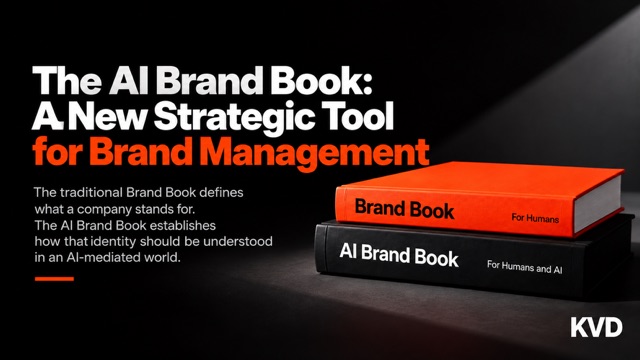
The AI Brand Book: A New Strategic Tool for Brand Management
The traditional Brand Book defines what a company stands for. The AI Brand Book establishes how that identity should be understood in an AI-mediated world.
By KVD · Published October 2026
For decades, companies have invested in controlling how their brands appear. They have developed visual identities, carefully crafted positioning statements, established tone-of-voice guidelines, and commissioned Brand Books to keep everyone reasonably consistent.
The objective was straightforward: ensure that customers encounter a recognizable brand, whether through an advertisement, website, sales presentation, or conversation with an employee.
Then artificial intelligence entered the picture.
Today, customers increasingly ask AI systems which companies to consider, which products solve a particular problem, and which brands deserve their attention. The answers may influence purchasing decisions before a customer ever visits a company's website.
This introduces a rather inconvenient complication for brand management.
A company can control what it says about itself. It cannot directly control what artificial intelligence says about it.
And that is precisely why the AI Brand Book deserves a place alongside the traditional Brand Book.
From Brand Identity to Brand Understanding
A traditional Brand Book establishes the principles that guide a brand's expression.
It typically defines the company's purpose, positioning, personality, visual identity, messaging, and communication standards. At its best, it does considerably more than specify which shade of blue belongs in a presentation.
It articulates what the brand should mean.
This remains essential. Without a clear strategic foundation, companies risk communicating different stories to different audiences, weakening the associations they have worked so hard to establish.
However, the traditional Brand Book was developed for an environment in which people and organizations largely controlled brand communication.
Artificial intelligence changes that relationship.
AI systems interpret information from websites, publications, reviews, third-party references, product descriptions, and numerous other sources. They synthesize that information into answers that may summarize, compare, or recommend brands.
They do not necessarily reproduce the company's preferred positioning.
Instead, they construct an understanding from the information available to them.
A brand might describe itself as an innovative enterprise technology partner, while AI consistently categorizes it as a conventional software vendor. A specialist company might be understood correctly but rarely included when relevant solutions are recommended.
Both situations matter. Neither is solved simply by updating a logo or refining a tagline.
What Is an AI Brand Book?
An AI Brand Book is a strategic reference framework that defines a brand's Intended Brand Understanding and translates it into clear, consistent, evidence-supported information for AI-mediated discovery, interpretation, and consideration.
It does not replace the traditional Brand Book. It extends its strategic purpose into an environment where brands are increasingly interpreted by systems that companies do not own or control.
Where a traditional Brand Book asks, How should our brand be expressed?, an AI Brand Book asks an additional question:
What should artificial intelligence understand about our brand, and what evidence should support that understanding?
This distinction is important.
The objective is not to persuade an AI system to repeat a marketing slogan. Nor is it to manufacture favorable recommendations regardless of relevance.
It is to establish a sufficiently clear, credible, and consistent brand narrative that AI systems have a better basis for accurately interpreting what the company does, whom it serves, how it differs, and when it deserves consideration.
In other words, the AI Brand Book turns brand strategy into a practical reference for an increasingly important new audience: artificial intelligence.
Five Elements of an AI Brand Book
Although every organization requires a different level of detail, KVD sees five essential elements in an effective AI Brand Book.
1. Intended Brand Understanding
Everything begins with a definition of what the company wants to be understood for.
This includes its market category, target audiences, core capabilities, distinctive value, and the problems it is particularly qualified to solve.
The definition should be specific enough to distinguish the brand from competitors.
“An innovative, customer-focused technology company” is not a useful strategic position. It could describe half the exhibitors at a technology conference.
A stronger definition explains what the company actually delivers, for whom, in which situations, and why that matters.
2. Brand Knowledge Architecture
The next step is organizing the information that supports the intended understanding.
This includes consistent descriptions of products, services, applications, industry terminology, customer segments, and relevant relationships between them.
A company may use several different descriptions of the same capability across its website, investor materials, product pages, and external profiles.
Humans can sometimes reconcile these differences. AI systems may interpret them as separate offerings or produce an incomplete account.
A coherent knowledge architecture reduces unnecessary ambiguity without flattening the brand into generic language.
3. Differentiation and Evidence
Brand positioning requires more than assertions.
If a company claims to be a leader, a specialist, or an innovator, what credible evidence supports that claim?
The AI Brand Book should connect important brand associations to verifiable information: documented capabilities, relevant expertise, certifications, case studies, published research, or other substantiated proof points.
This is particularly important because AI-generated answers may combine information from multiple sources.
A claim repeated across a company's own marketing materials is not necessarily equivalent to independent evidence.
The ambition should be accurate understanding, not artificial authority.
4. Competitive and Category Context
Brands do not exist in isolation. They are understood relative to alternatives.
An AI Brand Book should therefore define the categories in which the brand belongs, the competitors and substitutes against which it may reasonably be compared, and the situations in which its offering is relevant.
This is not about forcing a brand into every possible recommendation.
It is about identifying where the brand has a legitimate claim to consideration.
For a specialist company, appearing in ten highly relevant comparisons may be more commercially valuable than appearing in a hundred unrelated answers.
5. Governance and Measurement
An AI Brand Book cannot be treated as a document that is completed once and forgotten.
Companies change. Products evolve. Markets shift. Competitors introduce new capabilities. AI systems and their information sources also change.
The framework therefore needs clear ownership, an updating process, and measurable indicators of whether the intended understanding is reflected in AI-generated responses.
The AI Brand Book establishes the reference point. Measurement reveals the distance between intention and reality.
That distance is where the AI Brand Gap™ becomes relevant.
The AI Brand Gap™: From Assumption to Diagnosis
Most companies have a reasonably clear view of how they would like to be perceived.
Far fewer have systematically examined how artificial intelligence currently describes and recommends them.
At KVD, we distinguish between two connected dimensions of the AI Brand Gap™.
The first is the Understanding Gap: the difference between a brand's Intended Brand Understanding and the understanding expressed by AI systems.
The second is the Consideration Gap: the difference between the situations in which a brand should reasonably be considered and the situations in which AI actually includes or recommends it.
These dimensions are related, but they are not identical.
A company can be accurately understood and still be overlooked.
Another can appear frequently in AI-generated recommendations while being associated with the wrong capabilities, customers, or market position.
KVD's AI Brand Gap™ Quadrant describes four possible conditions:
- Aligned: The brand is understood and considered for the right reasons.
- Overlooked: The brand is understood but insufficiently considered.
- Mispositioned: The brand receives consideration, but its positioning is misunderstood.
- Excluded: The brand is neither adequately understood nor considered.
The purpose of this framework is not to assign a fashionable score to a complicated problem.
It is to identify the nature of the problem before deciding how to address it.
A brand that is misunderstood requires different action from one that is correctly understood but rarely recommended.
Without a defined Intended Brand Understanding, however, even that diagnosis becomes difficult.
After all, how can a company identify a gap if it has never clearly established the position from which the gap should be measured?
Why Visibility Alone Is Not Enough
Much of the emerging conversation around AI and marketing focuses on discoverability.
Companies are investigating Generative Engine Optimization (GEO), Answer Engine Optimization (AEO), structured content, and other approaches intended to improve their presence in AI-generated answers.
These activities can be useful. Making accurate information easier to find, interpret, and verify is a sensible objective.
But visibility is not the same as understanding.
And understanding is not automatically the same as consideration.
A company could become more visible while reinforcing an outdated or inaccurate market position. It might appear more often in answers without being associated with the qualities that make it commercially distinctive.
This is the danger of optimizing the distribution of a message before examining whether the message is strategically correct.
The AI Brand Book provides a reference against which such activity can be assessed.
It connects tactical discoverability efforts to a deliberate brand strategy rather than allowing technical optimization to define the brand by default.
From the AI Brand Book to the AI Brand Campaign
A framework alone will not change how a brand is understood.
Once a company has defined its intended position and diagnosed the AI Brand Gap™, it must address the underlying causes.
At KVD, this leads to the AI Brand Campaign: a coordinated program designed to improve the consistency, clarity, credibility, and availability of information that shapes AI-mediated brand understanding and consideration.
Depending on the diagnosis, the work may involve refining website content, improving product and service descriptions, developing credible supporting evidence, aligning external profiles, strengthening relevant editorial coverage, or resolving contradictions across information sources.
The objective is not to manipulate an AI model or guarantee a particular answer.
No company can promise that every AI system will interpret a brand identically, or that a specific brand will always be recommended.
The objective is to improve the conditions under which accurate understanding and appropriate consideration become more likely.
The process also requires repeated assessment. Different AI systems may produce different responses, and their behavior may change over time.
This makes AI brand management an ongoing strategic discipline rather than a one-off optimization project.
A New Responsibility for Brand Leadership
The arrival of AI-mediated discovery does not make traditional brand management obsolete.
Quite the opposite.
It raises the value of a clear, differentiated, and well-supported brand strategy.
Marketing leaders now need to consider not only how their brand is expressed across channels, but also how it is interpreted when an AI system becomes the intermediary between a customer and a purchasing decision.
That responsibility extends beyond marketing communications. Product teams, commercial leaders, subject-matter experts, and corporate communications all contribute information that may influence the brand's wider understanding.
The traditional Brand Book helps these teams speak with one voice.
The AI Brand Book helps them establish a coherent body of knowledge about what the brand means, what it offers, and why it deserves consideration.
One guides expression. The other guides the intended understanding that expression and supporting evidence should create.
Together, they offer a more complete foundation for managing brands in an AI-mediated market.
The Next Chapter of Brand Management
For years, brand leaders have asked a familiar question:
Are we communicating the right message to the right audience?
They now face another:
When our audience asks artificial intelligence about our market, does it understand who we are, what makes us different, and when we deserve to be considered?
That question cannot be answered by website traffic, search rankings, or AI mention counts alone.
It requires a clearly defined intended position, an assessment of current AI understanding and consideration, and a coordinated effort to close the gaps.
The AI Brand Book is not another set of brand guidelines designed to gather digital dust.
It is a strategic tool for connecting what a company intends its brand to mean with the increasingly influential systems that interpret that meaning on its behalf.
The future of brand management is not simply about being seen. It is about being understood, accurately and for the right reasons.
About KVD
KVD is a strategic AI marketing consultancy based in Cambridge, Massachusetts, helping companies build brands for humans and AI. Through Brand Books, AI Brand Books, AI Brand Gap™ assessments, and AI Brand Campaigns, KVD helps organizations define their Intended Brand Understanding, diagnose the difference between intention and AI interpretation, and develop coordinated programs to address it.
Learn more at www.kvd.one.
This is the fourth article in KVD's five-week editorial series exploring the AI Brand Gap™, Brand Books, AI Brand Books, and the evolving responsibilities of brand management in the age of artificial intelligence.
Next article: From Brand Visibility to Brand Gravity: Why AI Understanding Drives Consideration.