
AI Brand Strategy
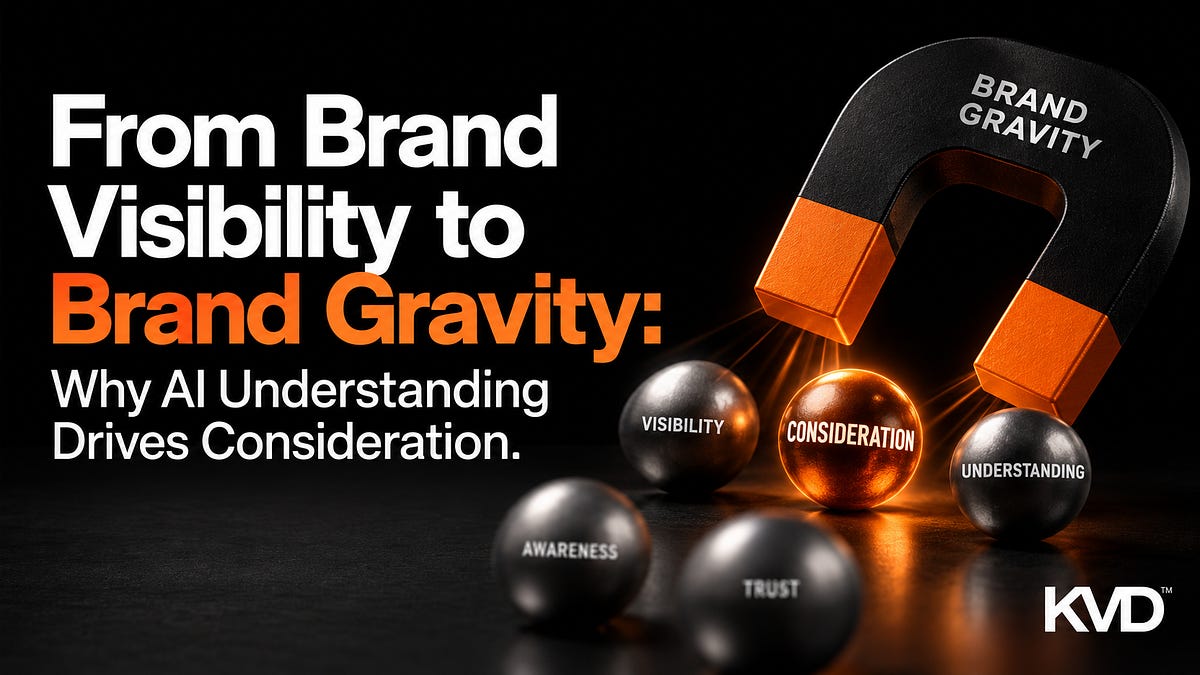
From Brand Visibility to Brand Gravity: Why AI Understanding Drives Consideration
Being visible to artificial intelligence is one thing. Being understood, trusted, and considered for the right reasons is quite another.
By KVD · Published October 2026
For much of the digital era, marketing success has been measured by a relatively straightforward ambition: getting noticed. Companies invested in search engine optimization, digital advertising, social media, content marketing, and increasingly sophisticated analytics. The objective was to appear in front of potential customers, attract attention, and convert that attention into commercial opportunities. The underlying assumption was simple. If customers could find you, they might consider you.
Artificial intelligence is complicating that assumption.
Today, a customer can ask an AI assistant to identify the most suitable companies in a particular industry, compare competing solutions, or recommend a supplier for a specific business challenge. The customer may receive a shortlist without visiting a search results page, clicking an advertisement, or encountering the company’s carefully designed website. For marketers, this creates a fundamental question.
What determines whether artificial intelligence merely knows a brand exists or considers it relevant enough to recommend?
The answer takes us beyond visibility and into a concept that KVD calls Brand Gravity.
The Visibility Obsession
Marketing has developed an impressive collection of tools for measuring visibility. Search rankings, impressions, website traffic, share of voice, brand mentions, and digital reach have become familiar indicators of market presence. These metrics remain useful. A company that nobody encounters will struggle to build awareness, regardless of how compelling its proposition might be. But AI-mediated discovery introduces a different dynamic.
When a customer asks an AI system to recommend a solution, the system is not simply presenting a directory of available companies. It is generating a response based on its interpretation of the question, the information available to it, and the relationships it can establish between a customer’s needs and potential solutions. That distinction matters. A brand can be widely mentioned online yet remain poorly understood. Another may have a smaller digital footprint but possess a clearer association with a particular problem, capability, or customer segment. The second brand may be more relevant to a specific recommendation, even if the first enjoys greater general visibility. Visibility, therefore, should not be confused with relevance. And relevance cannot be separated from understanding.
Introducing Brand Gravity
In traditional brand management, established brands benefit from accumulated associations. Years of advertising, customer experience, product performance, media coverage, and market presence shape what people believe a company represents. These associations create familiarity. They influence expectations. They can make certain brands feel like obvious choices within particular categories. Artificial intelligence introduces another environment in which established associations may matter.
At KVD, we use the term Brand Gravity to describe the influence of accumulated brand associations on how a company is interpreted, categorized, and considered within AI-mediated discovery. Brand Gravity is not a literal force, nor is it a proprietary mechanism inside an AI model. It is a strategic concept for understanding how a brand’s established market identity can continue to shape AI-generated descriptions and recommendations.
Consider a company that spent twenty years supplying traditional industrial equipment but has recently transformed itself into a provider of advanced automation technology. Its current positioning may emphasize intelligent systems, predictive capabilities, and integrated solutions. Yet much of the information available across the market may still describe the company primarily as an equipment manufacturer. The company has changed its strategy. Its accumulated associations have not necessarily changed with it. An AI system drawing on older, inconsistent, or more widely represented information may continue to describe the company through its historical identity. The result is a form of strategic inertia.
The brand has moved. Its perceived position has not moved at the same speed.
That is Brand Gravity at work.
When Brand Gravity Helps
Brand Gravity is not inherently a problem. For established companies, strong and accurate brand associations can be valuable. A brand consistently associated with a particular category, capability, or customer problem may be easier for AI systems to connect with relevant questions. Imagine a company known for highly specialized laboratory equipment. Over many years, it has developed technical documentation, published research, established partnerships, earned relevant certifications, and accumulated references from customers and industry publications. These sources reinforce a coherent understanding of what the company does and where its expertise lies.
When someone asks an AI assistant about suppliers in that specialist category, the company has a substantial body of relevant information supporting its position. That does not guarantee a recommendation. AI systems differ in their information sources, retrieval methods, and response behavior. But a consistent, credible information environment provides a stronger foundation for accurate interpretation. In this situation, Brand Gravity supports the company’s intended position. Its established identity and current strategy point in the same direction.
When Brand Gravity Becomes a Liability
The problem emerges when accumulated associations no longer reflect the company’s intended position. This happens more frequently than many marketing leaders might expect. Companies expand into new markets, acquire businesses, introduce new technologies, reposition their offerings, or fundamentally change their business models. Their websites may communicate the transformation immediately. The wider information environment often takes considerably longer to catch up.
An enterprise software company may still be associated with a product it discontinued years ago.
A healthcare technology business may be described through an earlier generation of its platform.
A consultancy may have shifted from traditional marketing services to strategic AI brand management, while external descriptions continue to emphasize its historical capabilities.
In each case, the company faces a mismatch between what it intends to represent and what available information suggests it represents. This mismatch can influence AI-generated understanding. More importantly, it may influence consideration. If an AI assistant interprets a company as belonging to the wrong category, it may overlook that company when a relevant customer asks for recommendations. Alternatively, it may recommend the company for reasons that no longer reflect its actual strengths. Both outcomes can create commercial disadvantages. The first makes the brand less likely to enter the conversation. The second brings it into the wrong conversation.
Understanding Comes Before Consideration
This is where Brand Gravity connects directly to KVD’s AI Brand Gap™ framework. We distinguish between two dimensions of the gap.
The Understanding Gap measures the difference between a brand’s Intended Brand Understanding and how AI systems actually describe and interpret it.
The Consideration Gap examines whether AI systems include or recommend the brand in situations where it has a legitimate claim to relevance.
These dimensions should be examined separately. A company may be accurately understood but rarely recommended. Another may appear frequently in recommendations while being associated with outdated or incorrect capabilities. KVD’s AI Brand Gap™ Quadrant captures four possible conditions:
Aligned: The brand is understood and considered for the right reasons.
Overlooked: The brand is understood but insufficiently considered.
Mispositioned: The brand receives consideration, but its positioning is misunderstood.
Excluded: The brand is neither adequately understood nor considered.
Brand Gravity can help explain why a company occupies a particular position within this framework. Strong historical associations may reinforce accurate understanding and appropriate consideration. But those same associations may also preserve an outdated identity, contributing to mispositioning or exclusion from newly relevant categories. The implication is important.
More visibility will not necessarily close an AI Brand Gap™ if the underlying brand associations remain incorrect.
In some cases, increasing visibility without correcting the information environment may simply reinforce the wrong position.
The Difference Between Being Known and Being Chosen
Consider two hypothetical companies operating in the same market. Company A is highly visible. It publishes frequently, invests in digital marketing, and appears across numerous industry websites. However, its messaging is inconsistent. One source describes it as a technology provider. Another calls it a consultancy. Its website emphasizes enterprise solutions, while external profiles still reference products that are no longer central to its business. Company B has a smaller digital footprint. But its positioning is specific. Its capabilities are clearly described. Its target customers are consistently identified. Its case studies, technical documentation, and external references support the same strategic narrative. Which company will AI recommend?
There is no universal answer. The outcome depends on the question, the AI system, the information available, and numerous other factors. Nevertheless, Company B offers a more coherent basis for accurate understanding. That coherence matters because consideration requires more than recognition. It requires a meaningful connection between a customer’s problem and a company’s capabilities. In traditional marketing language, this resembles the difference between brand awareness and being included in the consideration set. AI has not eliminated that distinction. It has introduced a new intermediary into the process.
Why GEO and AEO Are Not Enough
The emergence of Generative Engine Optimization (GEO) and Answer Engine Optimization (AEO) reflects an understandable marketing response. If customers increasingly discover companies through AI-generated answers, businesses want to improve their presence within those answers. There is value in making information accessible, structured, current, and easy to interpret. But discoverability is only part of the challenge.
A company can optimize its website for AI discovery while leaving its broader market identity unresolved. It can produce additional content without addressing contradictions between its current positioning and its historical reputation. It can increase the number of times its name appears without improving the reasons for which it is considered. These are not necessarily technical failures. They are strategic brand management failures. GEO and AEO can support a broader effort, but they cannot independently determine what a brand should mean. That requires brand strategy. And it begins with a clear definition of Intended Brand Understanding.
Managing Brand Gravity
If Brand Gravity represents the influence of accumulated associations, managing it requires more than publishing a revised positioning statement. Companies must first establish what they want to be understood for. This is the role of the traditional Brand Book and its extension into the AI Brand Book. The traditional Brand Book defines the company’s strategic identity and how that identity should be expressed. The AI Brand Book translates that strategy into a structured reference for AI-mediated understanding and consideration. It clarifies the company’s category, capabilities, target audiences, differentiation, supporting evidence, and relevant competitive context. Together, these frameworks establish the intended position.
The next step is diagnosis.
An AI Brand Gap™ assessment examines how selected AI systems currently describe the company, which associations they reproduce, and under which relevant circumstances they include or exclude the brand. The assessment should use representative questions, clearly defined evaluation criteria, and repeated observations rather than treating a handful of AI responses as definitive evidence. This helps identify whether the primary challenge concerns understanding, consideration, or both. Only then should a company decide how to intervene.
At KVD, this leads to the AI Brand Campaign.
From Diagnosis to an AI Brand Campaign
An AI Brand Campaign is a coordinated program intended to improve the information environment that shapes AI-mediated brand understanding and consideration. Its purpose is not to manipulate AI systems into recommending a company regardless of relevance. It is to make the company’s intended position clearer, more consistent, and better supported by credible information. Depending on the diagnosis, this may involve updating outdated descriptions, strengthening product and service information, developing supporting evidence, aligning relevant external profiles, improving category clarity, or creating authoritative content that explains the company’s actual capabilities. The work may also require coordination across departments.
Marketing cannot correct an outdated brand understanding if product documentation, sales materials, corporate communications, and third-party references continue to tell conflicting stories. Consistency must extend beyond the marketing department. The effectiveness of these efforts then needs to be assessed over time. AI-generated responses are variable. Different systems may interpret the same information differently, and changes in their underlying models or retrieval processes may affect results. Consequently, no responsible AI brand management program should promise permanent rankings, guaranteed recommendations, or complete control over AI-generated answers.
The objective is more realistic and strategically useful:
Improve the likelihood that a brand is understood accurately and considered when it is genuinely relevant.
The New Brand Management Challenge
For years, marketing leaders have worked to build strong associations in the minds of customers. They have invested in positioning, advertising, reputation, customer experience, and consistent communication. These activities remain essential. What has changed is the environment in which those associations are interpreted. Customers increasingly rely on AI systems to summarize markets, compare alternatives, and identify potential suppliers. The brand is no longer communicating exclusively through channels it manages or through intermediaries it understands well. It is also being interpreted by systems that synthesize information from multiple sources and generate their own descriptions. This introduces a new responsibility for brand leadership.
Companies must understand not only whether their intended positioning is reaching customers, but also whether AI-mediated discovery reflects that positioning accurately. They must recognize that accumulated brand associations can support their ambitions or hold them back. And they must distinguish between being visible, being understood, and being considered. These are three different outcomes. They require different measures and, frequently, different interventions.
From Visibility to Strategic Relevance
The marketing industry has spent decades perfecting the art of being found. Artificial intelligence is making the next question more important.
When we are found, are we understood correctly?
And beyond that:
When customers ask AI for help making a decision, does our brand deserve to be part of the answer?
Brand Gravity offers a way to think about the accumulated associations that influence those outcomes. The AI Brand Gap™ provides a framework for diagnosing the difference between intended understanding and observed AI behavior. The AI Brand Book establishes the strategic reference. And the AI Brand Campaign provides a coordinated approach to addressing the gaps. Together, they shift the conversation from technical visibility toward strategic brand management. Because in an AI-mediated market, the most important objective is not simply to appear in more answers.
It is to become relevant to the right questions, understood for the right reasons, and considered when the brand can genuinely deliver value.
About KVD
KVD is a strategic AI marketing consultancy based in Cambridge, Massachusetts, helping companies build brands for humans and AI.
Through Brand Books, AI Brand Books, AI Brand Gap™ assessments, and AI Brand Campaigns, KVD helps organizations define their Intended Brand Understanding, assess how artificial intelligence currently interprets their brands, and develop coordinated programs to address the differences.
Learn more at www.kvd.one.
This is the fifth article in KVD’s five-week editorial series exploring the AI Brand Gap™, Brand Books, AI Brand Books, and the evolving responsibilities of brand management in the age of artificial intelligence.
Next article: The AI Brand Gap™ Quadrant: Four Positions Every Brand Leader Should Understand.