
AI Brand Measurement
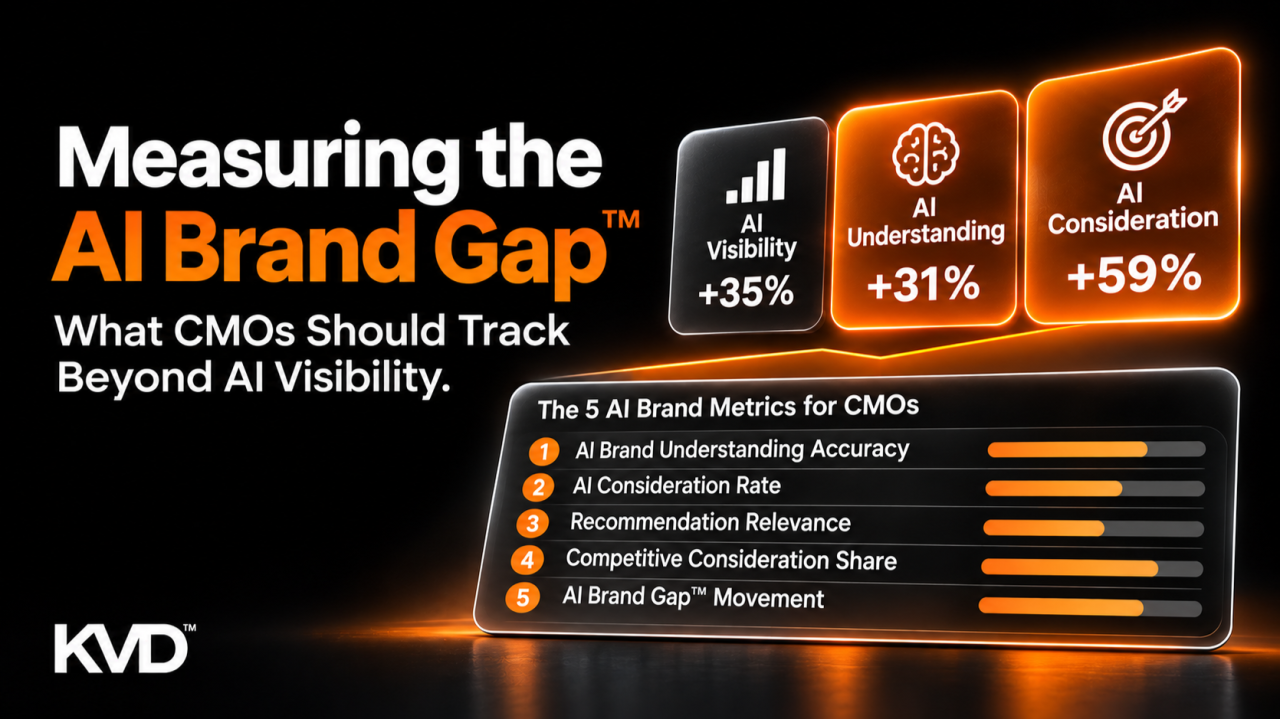
Measuring the AI Brand Gap™: What CMOs Should Track Beyond AI Visibility
Your brand appears in AI-generated answers. Excellent. But is it understood correctly, recommended for the right reasons, and becoming more relevant to the customers you want to reach? That requires a different kind of marketing dashboard.
By KVD · Published November 2026
Marketing departments have developed an impressive ability to measure almost everything. Website traffic, search rankings, conversion rates, customer acquisition costs, brand awareness, share of voice, engagement, and marketing attribution have become standard features of the modern CMO's dashboard. Artificial intelligence is now introducing another collection of metrics. Companies are beginning to track how frequently their brands appear in ChatGPT, Gemini, Perplexity, and other AI-powered environments. New monitoring platforms promise insights into AI visibility, brand mentions, recommendation frequency, and competitive positioning.
For marketing leaders, this is a welcome development.After all, if customers increasingly use artificial intelligence to discover companies, compare suppliers, and evaluate solutions, understanding how their brands appear in these environments is commercially important. But there is a problem.
Being mentioned by artificial intelligence is not the same as being understood. And being understood is not the same as being considered.
A company may appear frequently in AI-generated answers while being associated with outdated capabilities. Another may be described accurately but rarely included in relevant recommendations. A third may receive more AI mentions than its competitors, yet those mentions may have little connection to the customer problems it actually solves. A dashboard celebrating increased visibility could therefore conceal a strategic problem.
At KVD, we believe the next generation of AI brand measurement must move beyond counting appearances. It must examine the relationship between Intended Brand Understanding, AI Understanding, and AI Consideration. That relationship is at the heart of the AI Brand Gap™.
The Problem With Counting Mentions
Marketing has always favored metrics that are relatively easy to collect. Impressions are easier to measure than genuine interest. Clicks are easier to measure than persuasion. Social media engagement is easier to quantify than long-term brand preference. This does not make these metrics useless. It simply means that they are indicators of particular activities, not complete measures of brand performance. AI visibility presents a similar challenge. Suppose a company appears in 40% of a defined sample of AI-generated answers about its industry. Three months later, that figure increases to 55%. A conventional dashboard might report a substantial improvement.
But what if most of those additional mentions describe the company as a traditional software vendor when it has repositioned itself as a specialist cybersecurity provider? What if AI systems recommend the company for products it no longer sells? What if the company appears more often in broad industry descriptions but remains absent from recommendations addressing its most commercially valuable customer needs? The visibility metric has improved. The brand's strategic position may not have.
A mention tells you that a brand appeared. It does not tell you whether the appearance was accurate, relevant, or commercially meaningful.
That distinction should fundamentally change how CMOs evaluate AI brand performance.
Start With Intended Brand Understanding
Before measuring how artificial intelligence represents a brand, companies need to define what they want that representation to be. At KVD, we call this Intended Brand Understanding. It describes the market position a company intends to establish. This includes its category, core capabilities, target customers, differentiation, value proposition, and the circumstances in which its offerings deserve consideration. For example, a company might define itself as a specialist provider of remote patient monitoring technology for healthcare organizations. That definition should go beyond a broad category label. It should identify the relevant capabilities, applications, customer segments, and credible points of differentiation. The objective is to establish a clear strategic reference. Without it, companies risk evaluating AI-generated responses against vague expectations.
A marketing team may celebrate a favorable description without recognizing that it emphasizes the wrong capabilities. Another may be disappointed by the absence of a recommendation even though the customer's question falls outside the company's actual market relevance. Intended Brand Understanding creates the reference against which AI performance can be assessed. The traditional Brand Book establishes the strategic identity.
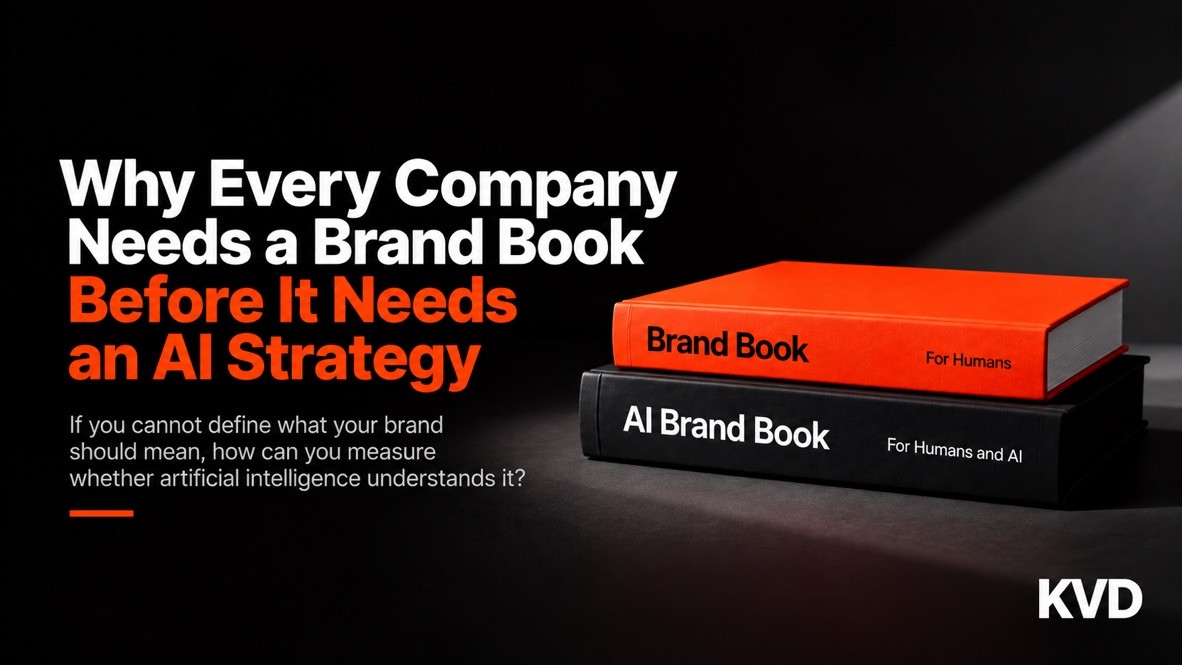
The AI Brand Book translates that identity into a structured framework for AI-mediated understanding and consideration. Together, they answer the question that must precede measurement:
What should artificial intelligence understand about our brand, and when should it reasonably consider us?
Two Dimensions of the AI Brand Gap™
The AI Brand Gap™ distinguishes between two related but separate dimensions.
The first is the Understanding Gap.
This describes the difference between a brand's Intended Brand Understanding and how AI systems actually interpret and describe it.
The second is the Consideration Gap.
This examines whether AI systems include or recommend a brand in situations where its capabilities make it a legitimate option. These dimensions should not be combined into a single visibility metric. A brand may perform well on understanding but poorly on consideration. Another may appear frequently in recommendations while being associated with the wrong market position.
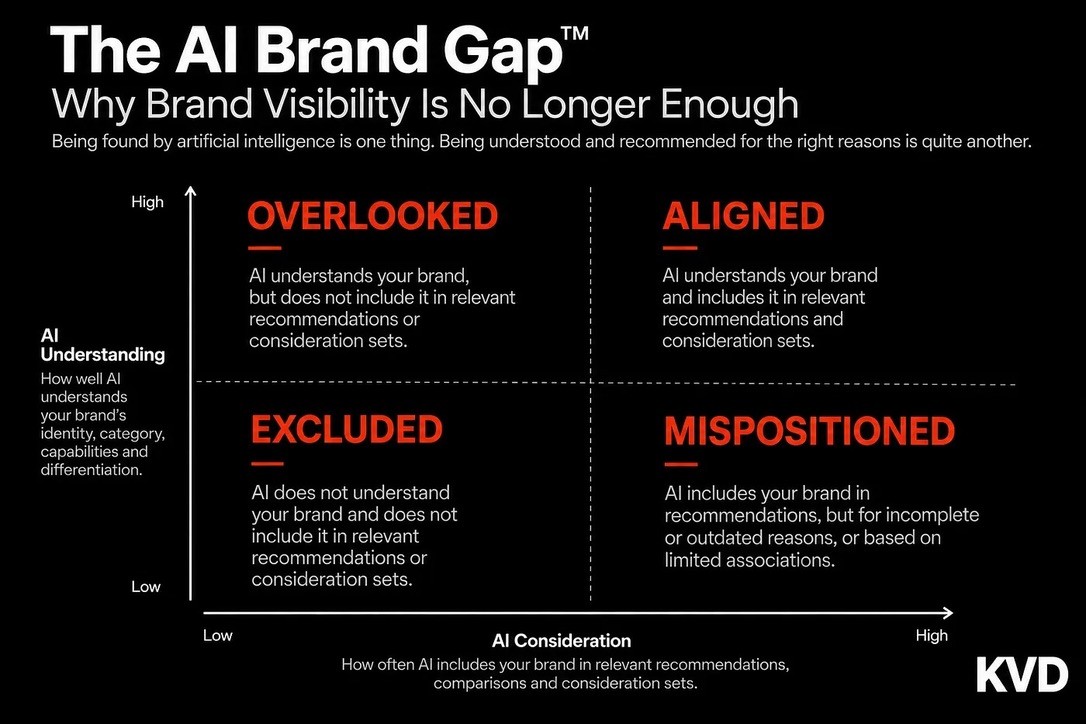
In Article 6, we introduced KVD's AI Brand Gap™ Quadrant, which identifies four conditions:
Aligned: High AI Understanding and high AI Consideration. The brand is understood and considered for the right reasons. Overlooked: High AI Understanding and low AI Consideration. The brand is understood but insufficiently considered. Mispositioned: Low AI Understanding and high AI Consideration. The brand receives consideration, but its positioning is misunderstood. Excluded: Low AI Understanding and low AI Consideration. The brand is neither adequately understood nor considered.
This framework helps marketing leaders distinguish between different strategic problems. It also establishes the foundation for a more useful measurement system. The objective is not simply to determine whether a company is visible. It is to understand whether the brand is moving toward the Aligned position within its relevant market.
Five Metrics Every CMO Should Understand
There is no universally accepted measurement standard for AI brand understanding and consideration. Different monitoring platforms use different methodologies, and AI-generated responses vary across models, prompts, and time periods. Nevertheless, companies can develop a disciplined measurement framework using clearly defined indicators. At [KVD](/), we recommend five complementary metrics.
1. AI Brand Understanding Accuracy
The question: Does artificial intelligence describe the brand in accordance with its Intended Brand Understanding? This metric evaluates whether AI-generated descriptions accurately represent the company's intended category, capabilities, target audiences, differentiation, and relevant applications. A company might define five essential elements of its positioning. Each AI-generated response can then be evaluated against those elements using documented criteria.
For example:
Is the company's primary market category identified correctly? Are its core capabilities accurately represented? Are its intended customers recognized? Is its differentiation described without material distortion? Are outdated or incorrect associations avoided?
The results can be summarized as an understanding accuracy score. However, the scoring method must be transparent. Not every positioning element carries equal strategic importance, and the absence of a minor detail should not necessarily receive the same penalty as an incorrect market category. The purpose is not to manufacture a precise-looking number. It is to measure whether AI understanding is becoming more consistent with the company's intended position.
2. AI Consideration Rate
The question: How often is the brand included when customers ask AI systems for relevant recommendations? This metric examines whether a company appears in recommendations and comparisons where it has a legitimate claim to consideration. The starting point is a carefully designed set of customer questions. These questions should reflect realistic discovery and evaluation situations. For a specialist technology company, they might involve particular industry challenges, applications, supplier categories, or technical requirements. The company then measures how frequently selected AI systems include it among relevant options.
For example, if a brand appears in 18 of 60 eligible recommendation responses, its observed consideration rate is 30%.
That figure is meaningful only within the defined assessment. It should not be interpreted as a universal probability of recommendation across all AI systems or customer interactions. The selection of questions matters enormously. A company can inflate its apparent performance by asking questions that favor its own capabilities. A credible assessment must use representative customer needs and consistent eligibility criteria.
3. Recommendation Relevance
The question: When AI recommends the brand, does it do so for the right reasons? This is one of the most important distinctions in AI brand measurement. A recommendation is not necessarily a positive outcome. Imagine a company that has moved away from traditional infrastructure services toward advanced cloud security. AI systems may continue recommending it for legacy infrastructure projects. The brand appears in the consideration set. But the recommendation reinforces an outdated position. Recommendation Relevance evaluates whether the reasons given for including the brand correspond to its actual capabilities and Intended Brand Understanding.
A company might classify observed recommendations as:
Relevant: The recommendation accurately matches the company's capabilities and customer needs. Partially relevant: The recommendation contains a valid connection but includes incomplete or outdated reasoning. Misaligned: The recommendation is based primarily on incorrect capabilities, inappropriate applications, or outdated positioning.
This creates a distinction between being chosen and being chosen appropriately. For companies undergoing repositioning, this metric may be more strategically important than overall recommendation frequency.
4. Competitive Consideration Share
The question: How does the brand's presence in relevant AI-generated recommendations compare with credible alternatives? Customers rarely evaluate brands in isolation. They ask AI systems to compare suppliers, identify leading solutions, or recommend alternatives within a category. Competitive Consideration Share measures a brand's relative presence within a defined set of relevant recommendation responses. For example, a company might compare its inclusion frequency with three established competitors across the same question set. This can reveal whether the brand is being overlooked despite accurate understanding. It can also help identify categories where competitors have stronger associations. However, competitive consideration is not necessarily a zero-sum measure. An AI response may include several brands, and the number of recommendations can vary. The methodology should therefore explain whether it measures inclusion frequency, share of total brand mentions, or another clearly defined indicator. Comparisons are useful only when the underlying questions, models, and evaluation periods are consistent. The goal is not to win an arbitrary ranking. It is to understand the brand's relative position within commercially relevant situations.
5. AI Brand Gap™ Movement
The question: Is the brand moving closer to its intended position over time? The previous metrics provide individual signals. AI Brand Gap™ Movement connects them into a strategic assessment. A company may begin in the Mispositioned quadrant because AI systems frequently recommend it for outdated capabilities. Following a coordinated AI Brand Campaign, its understanding accuracy may improve. Recommendations may increasingly reflect its current offerings. Eventually, the brand may demonstrate both high understanding and appropriate consideration within the assessment scope. That represents movement toward Aligned. Similarly, an Overlooked brand may maintain high understanding accuracy while improving its consideration rate in relevant customer situations. The purpose of measuring movement is to distinguish genuine strategic progress from fluctuations in visibility. A company should be able to explain not only whether its metrics changed, but also what those changes mean for its brand position.
What an AI Brand Dashboard Could Look Like
Consider a hypothetical B2B technology company conducting an initial assessment across a defined set of AI systems and customer questions. AI-generated descriptions have become more consistent with the company's intended positioning. The brand appears more frequently in relevant recommendations. And the reasons supporting those recommendations are becoming more accurate. However, the figures require context.
Were the same customer questions used? Were the same AI systems evaluated? Did the company assess a comparable number of responses? Were the scoring criteria consistent? Could changes in model behavior or retrieval methods explain part of the improvement?
Without methodological consistency, even attractive numbers can be misleading. The purpose of the dashboard is therefore not simply to display percentages. It is to support informed decisions about the brand's strategic position.
Why Measurement Requires a Consistent Methodology
AI-generated responses are not static. Two users may receive different answers to similar questions. A system may produce different recommendations depending on wording, context, location, available retrieval sources, or model updates. The same question may also produce different responses over time. This makes AI brand measurement more complicated than checking a conventional search ranking. Companies should therefore establish a documented assessment protocol. The protocol should define which AI systems are evaluated, which customer questions are included, how frequently assessments occur, and how responses are scored. It should also distinguish between descriptive questions and recommendation questions. Understanding and consideration are different outcomes and should be measured accordingly. Repeated observations help reduce the risk of drawing conclusions from isolated responses.
A company might conduct assessments at regular intervals using a stable core set of questions, while introducing additional questions when its products or markets change. It should also record material changes in the assessment environment. If an AI platform introduces a new model or changes its retrieval behavior, the company may need to interpret subsequent results with additional caution. This does not make measurement impossible. It makes methodological discipline essential.
The value of an AI brand metric depends less on the sophistication of its dashboard than on the credibility of the assessment behind it.
Measuring Brand Gravity
In Article 5, we introduced Brand Gravity, KVD's concept describing how accumulated brand associations can influence AI-mediated understanding and consideration. This creates another important measurement challenge. A company may change its strategy faster than the wider information environment changes its understanding. Consider a business that historically operated as a conventional software vendor but now specializes in AI-enabled enterprise solutions. Its current website may clearly communicate the new position. Yet older articles, external directories, product descriptions, and established market associations may continue emphasizing the historical business. AI systems may reproduce those associations. The company should therefore monitor not only whether its intended position is recognized, but also whether outdated associations remain dominant. This can be assessed by tracking the frequency and significance of historical versus current positioning themes in AI-generated descriptions. For example, the company might examine whether references to its former category decline while accurate associations with its new capabilities increase. The objective is not to erase the company's history. Historical expertise may remain an important source of credibility. The objective is to ensure that established associations support rather than distort its current strategic position.
From Measurement to an AI Brand Campaign
Measurement becomes commercially useful when it informs action.
In Article 8, we introduced the AI Brand Campaign as a coordinated program designed to improve the clarity, consistency, credibility, and availability of information that shapes AI-mediated brand understanding and consideration. The measurement framework helps determine where such a campaign should focus. If understanding accuracy is low, the company may need to clarify its positioning and correct inconsistent information. If understanding is strong but consideration remains weak, the priority may be strengthening credible evidence of relevance within the appropriate categories. If recommendations are frequent but poorly aligned, the company may need to address outdated associations and misleading descriptions. If the brand performs well across both dimensions, the focus may shift toward maintaining consistency and monitoring change. This creates a connection between diagnosis, activation, and measurement.
At KVD, we describe the process through four stages:
Define. Diagnose. Activate. Measure.
The Brand Book and AI Brand Book establish the intended position. The AI Brand Gap™ assessment identifies the differences between intention and observed AI behavior. The AI Brand Campaign coordinates the response. Measurement evaluates whether the intended understanding and appropriate consideration are improving.
The process then repeats as the company, market, and AI environment evolve.
The Difference Between AI Performance and Business Performance
There is another distinction marketing teams should not overlook. Improving AI brand metrics does not automatically establish commercial impact. A company may achieve better understanding accuracy and higher consideration rates without immediately seeing more revenue. The relationship between AI-generated recommendations and actual purchasing behavior is complex. Customers may use several information sources. They may consult AI systems early in their research, then rely on colleagues, analysts, sales representatives, or procurement processes before making a decision. In many cases, the company may not know whether an AI-generated recommendation influenced the customer's consideration set. Consequently, AI brand metrics should be treated as indicators of brand performance within AI-mediated discovery, not direct substitutes for commercial outcomes. Where possible, companies should connect them with broader marketing and business measures. These may include qualified inbound inquiries, relevant website referrals, changes in customer awareness, consideration research, pipeline quality, and sales feedback. The objective is to investigate whether improvements in AI understanding and consideration are associated with meaningful commercial developments. But correlation should not automatically be interpreted as causation. A disciplined CMO will want evidence, not merely an attractive narrative connecting two rising lines on a dashboard.
The CMO's New Measurement Responsibility
Artificial intelligence is expanding the scope of brand management. Marketing leaders must continue monitoring awareness, preference, reputation, customer acquisition, and commercial performance. But they now face another question. How is the brand being interpreted by AI systems that increasingly participate in customer discovery and evaluation? This responsibility cannot be reduced to an SEO report. Nor can it be delegated entirely to a technical monitoring platform. The CMO must define what successful brand understanding looks like. That requires strategic clarity. The CMO must determine when the brand deserves consideration. That requires a realistic understanding of the company's capabilities and competitive position. And the CMO must evaluate whether observed AI behavior is moving toward those objectives. That requires disciplined measurement. Technology can collect responses, organize data, and support analysis. It cannot independently determine what the company's brand should mean. That remains a strategic management decision.
A Better Question for the Next Board Meeting
Imagine two marketing reports.
The first announces:
"Our AI visibility increased by 35% this quarter."
The second explains:
"AI systems are increasingly describing our brand in accordance with our intended positioning. Our inclusion in relevant recommendations has improved, and outdated associations are becoming less prominent. We have identified the remaining consideration gaps and are addressing them through a coordinated AI Brand Campaign."
Both reports may contain useful information. But the second connects measurement to strategy. It explains what changed, why the change matters, and what management intends to do next. That is the direction in which AI brand measurement needs to evolve. Companies should not abandon visibility metrics. They should put them in context. Because the real objective is not simply to appear more frequently in AI-generated answers. It is to ensure that the brand is accurately understood, meaningfully differentiated, and appropriately considered when customers are evaluating relevant solutions.
The future of AI brand measurement will not be defined by who counts the most mentions. It will be defined by who can demonstrate that artificial intelligence increasingly understands and considers their brand for the right reasons.
And that is what closing the AI Brand Gap™ should ultimately mean.
About KVD
KVD is a strategic AI marketing consultancy based in Cambridge, Massachusetts, helping companies build brands for humans and AI.
Through Brand Books, AI Brand Books, AI Brand Gap™ assessments, and AI Brand Campaigns, KVD helps organizations define their Intended Brand Understanding, diagnose how artificial intelligence currently interprets and considers their brands, and develop coordinated programs to address the differences.
Discover your AI Brand Gap™
Curious whether artificial intelligence understands your brand and considers it for the right reasons? Explore AIBrandGap.com to assess where your brand stands and discover how it aligns with the four positions of the AI Brand Gap™ Quadrant: Aligned, Overlooked, Mispositioned, and Excluded.
KVD at Imagination in Action, Cambridge
KVD co-founder Wilbert Kragten discussed the AI Brand Gap™ during the startup pitches at Imagination in Action (IIA) in Cambridge, Massachusetts, highlighting why brand understanding and consideration are becoming increasingly important in an AI-mediated economy.
View Wilbert Kragten's IIA speaker profile
Learn more about KVD at [www.kvd.one](/).
This is the ninth article in KVD's five-week editorial series exploring the AI Brand Gap™, Brand Books, AI Brand Books, and the evolving responsibilities of brand management in the age of artificial intelligence.
Next article: The Future of Brand Management: Building Brands for Humans and AI.