
AI Brand Strategy
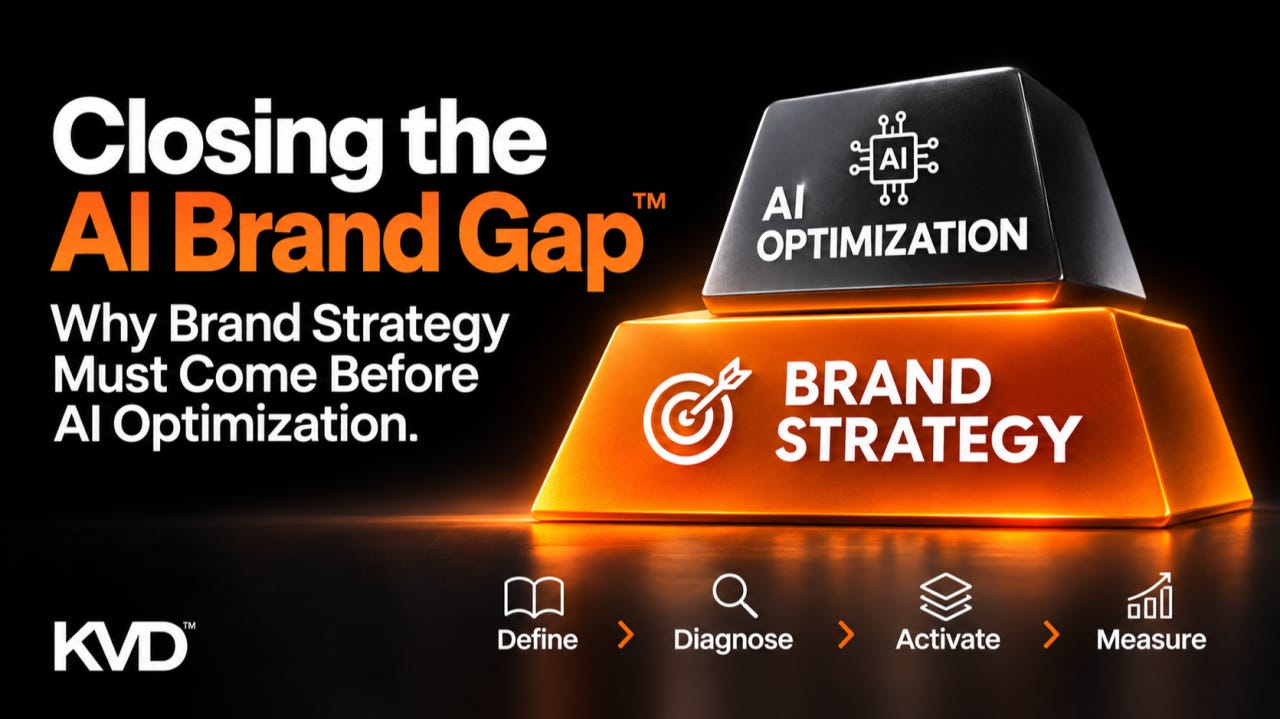
Closing the AI Brand Gap™: Why Brand Strategy Must Come Before AI Optimization
Companies are rushing to optimize their visibility in artificial intelligence. But before asking how to appear in more AI-generated answers, they should ask a more fundamental question: what should AI understand about their brand in the first place?
By KVD · Published November 2026
Artificial intelligence has given marketing departments a new problem to solve. Or, more accurately, a new collection of problems accompanied by an expanding collection of acronyms. Generative Engine Optimization (GEO), Answer Engine Optimization (AEO), AI search visibility, structured content, and AI discoverability have rapidly entered the marketing vocabulary. Consultancies are developing new services. Technology companies are introducing monitoring platforms. Marketing teams are experimenting with ways to increase their presence in AI-generated responses.
The underlying ambition is understandable.
If customers increasingly use artificial intelligence to identify suppliers, compare solutions, and make purchasing decisions, companies want to ensure their brands are part of those conversations. But something important is missing from much of this discussion.
Before a company can optimize how artificial intelligence represents its brand, it must establish what that representation should actually be.
Otherwise, it risks becoming more visible for the wrong reasons. At KVD, we believe this distinction is fundamental to closing the AI Brand Gap™.
The Optimization Reflex
Marketing has always been quick to develop techniques for improving performance within new channels. When search engines became central to digital discovery, companies invested in search engine optimization. When social media platforms became influential, marketers developed strategies for reach, engagement, and algorithmic visibility. When digital advertising became increasingly automated, businesses learned to optimize audiences, bidding strategies, creative assets, and conversion funnels. Each development introduced new capabilities, metrics, and specialized services.
Artificial intelligence is following a similar pattern. Companies now want to know how frequently their brands appear in ChatGPT, Gemini, Perplexity, and other AI-powered environments. They want to understand which competitors are recommended, which sources influence responses, and how to improve their visibility. And these are legitimate commercial questions.
The difficulty arises when optimization becomes the starting point rather than the consequence of a clearly defined strategy. A company might invest in producing more content, expanding its digital footprint, and increasing the number of references to its brand. But if those references reinforce an outdated position, the activity may make the underlying problem worse. The company becomes more visible. Its brand does not necessarily become better understood.
Optimization can amplify a message. It cannot determine whether that message is strategically correct.
That responsibility belongs to brand strategy.
The Difference Between Being Found and Being Understood
Consider a hypothetical industrial technology company. For twenty years, it has been recognized as a manufacturer of specialized mechanical components. More recently, it has transformed its business around intelligent automation, connected systems, and predictive maintenance. Its management team believes the company now competes in a fundamentally different category. Its website reflects the transformation. Its sales presentations emphasize advanced technology. Its leadership communicates a new strategic direction.
Yet the wider information environment tells a more complicated story. Industry directories still describe the company as a component manufacturer. Older publications associate it with traditional engineering products. Third-party profiles contain outdated descriptions. Customers and distributors continue using terminology associated with its historical business.
An AI system synthesizing this information may continue to interpret the company primarily through its former identity. Now imagine that the marketing team launches an aggressive AI visibility campaign without first examining this discrepancy. The company publishes more articles, distributes additional content, and seeks greater exposure across digital channels. If the content is inconsistent or insufficiently differentiated, the campaign may increase recognition without establishing the new position. The result is a familiar marketing problem in an unfamiliar environment.
The company is communicating more, but it is not necessarily communicating more clearly.
This is precisely the kind of challenge that the AI Brand Gap™ is intended to diagnose.
Define the Brand Before Measuring the Gap
Every meaningful assessment requires a reference point.
- A financial gap requires a target against which actual performance can be compared.
- A customer satisfaction gap requires an understanding of expectations.
- A brand positioning gap requires a definition of the position the company intends to occupy.
- AI brand management is no different.
At KVD, we refer to this reference point as the Intended Brand Understanding.
It describes what a company wants its brand to mean in the market. This includes its category, target audiences, core capabilities, differentiation, value proposition, and the circumstances in which its products or services deserve consideration. Importantly, Intended Brand Understanding should not be confused with a collection of marketing slogans. Statements such as “innovative,” “customer-centric,” and “a trusted partner” rarely provide sufficient differentiation. They may sound reassuring in a corporate presentation, but they tell an AI system relatively little about what makes a company relevant to a particular customer problem. A more useful definition is specific.
- What does the company actually deliver?
- Which problems does it solve?
- For whom?
- How does it differ from credible alternatives?
- What evidence supports those differences?
- And in which purchasing situations should the brand reasonably enter consideration?
Without answers to these questions, measuring the AI Brand Gap™ becomes an exercise in counting appearances rather than evaluating strategic alignment. A company may celebrate an increase in AI mentions while remaining uncertain whether those mentions communicate the right position.
Two Gaps, Two Different Challenges
As discussed in earlier articles, KVD distinguishes between two dimensions of the AI Brand Gap™.
The first is the Understanding Gap.
This concerns the difference between a brand’s Intended Brand Understanding and the understanding expressed by AI systems.
The second is the Consideration Gap.
This concerns whether AI systems include or recommend a brand in situations where its actual capabilities make it a legitimate option. These dimensions are connected, but they are not interchangeable. A company can be accurately understood and still be overlooked. Another can appear frequently in recommendations while being associated with the wrong products, capabilities, or market position.
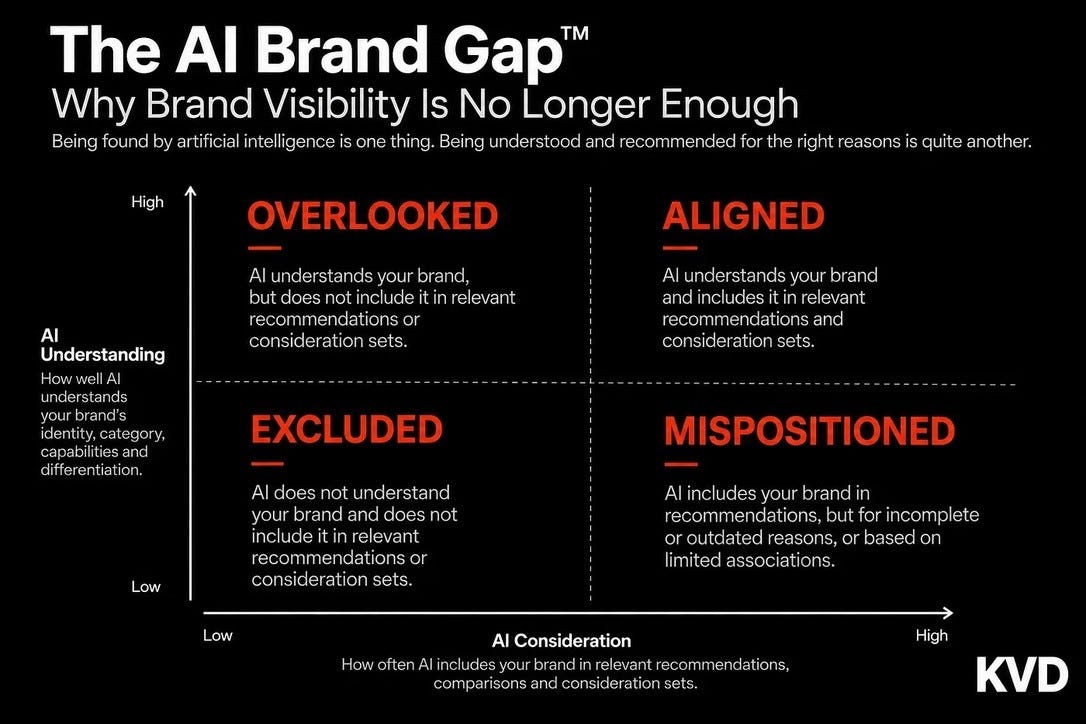
KVD’s AI Brand Gap™ Quadrant identifies four conditions:
- Aligned: High AI Understanding and high AI Consideration. The brand is understood and considered for the right reasons.
- Overlooked: High AI Understanding and low AI Consideration. The brand is understood but insufficiently considered.
- Mispositioned: Low AI Understanding and high AI Consideration. The brand receives consideration, but its positioning is misunderstood.
- Excluded: Low AI Understanding and low AI Consideration. The brand is neither adequately understood nor considered.
These positions have different strategic implications.
An Overlooked company may need to strengthen the evidence supporting its relevance within a particular category.
A Mispositioned company may need to correct outdated associations.
An Excluded company may first need to establish a coherent identity and information foundation.
An Aligned company may focus on maintaining its position as markets and AI systems evolve.
A generic AI optimization campaign cannot be expected to address all four conditions equally.
The correct intervention depends on the gap being diagnosed.
This is why strategy must precede optimization.
The Role of the Brand Book
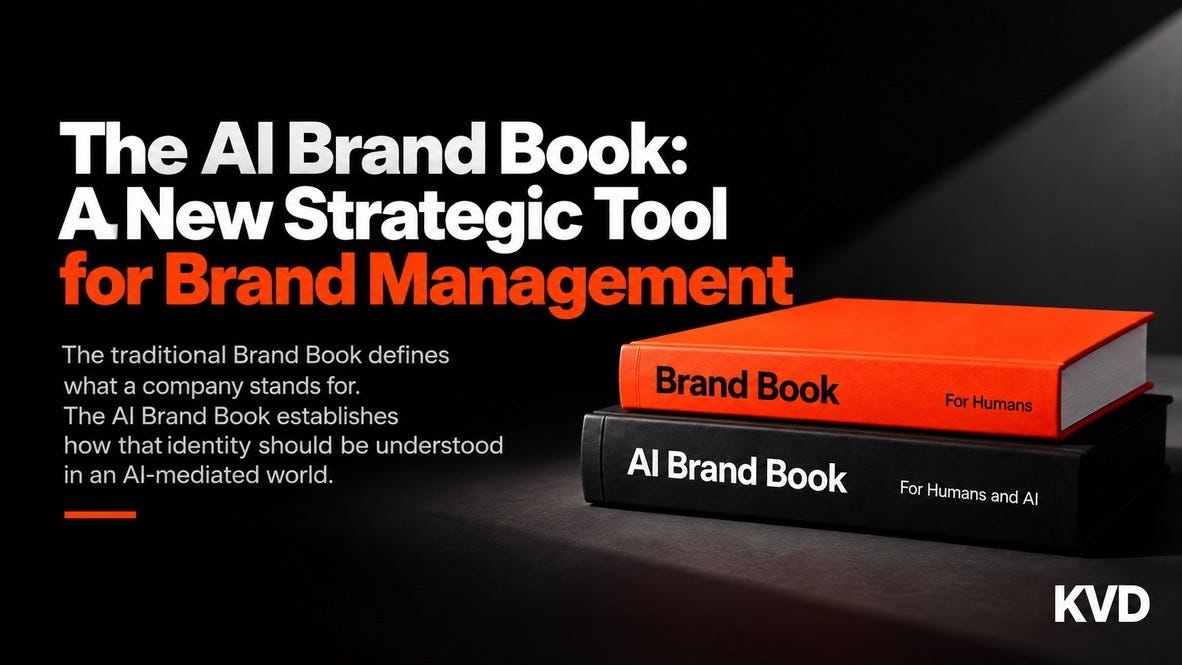
The traditional Brand Book remains one of the most important foundations of coherent brand management. At its best, it defines far more than visual identity. It establishes the brand’s purpose, positioning, differentiation, personality, value proposition, and communication principles. It provides an internal reference for how the organization should express itself. Yet many companies treat their Brand Books primarily as design manuals. They specify logos, typography, color palettes, and tone of voice, while providing relatively limited guidance on the company’s intended market understanding.
This is a missed opportunity.
A strong Brand Book should answer the strategic questions that precede communication.
- What does the brand stand for?
- What distinguishes it?
- Which associations should customers develop?
- Why should the brand matter?
These questions become even more important when artificial intelligence enters the discovery process. AI systems do not simply reproduce a company’s visual identity or preferred tagline. They interpret information and generate responses based on available sources, context, and their underlying models. A Brand Book therefore provides the strategic foundation, but it must be translated into a framework suited to AI-mediated understanding. This is where the AI Brand Book enters the picture.
The AI Brand Book: Translating Strategy Into Understanding
An AI Brand Book extends traditional brand strategy into the information environment that influences how AI systems interpret and consider brands. It defines the company’s Intended Brand Understanding and organizes the information needed to support that understanding. This includes its market category, products, services, capabilities, customer segments, differentiation, relevant applications, competitive context, and credible supporting evidence. The objective is not to create a secret instruction manual for artificial intelligence. Nor is it to persuade AI systems to repeat promotional claims. It is to establish a clear, consistent, and evidence-supported reference for what the company actually represents.
For example, a technology company may describe itself differently across its website, product documentation, investor materials, industry directories, and external publications. Some variation is inevitable because different audiences require different levels of detail. But material contradictions can create ambiguity.
An AI Brand Book helps identify the information that should remain strategically consistent, even when the wording and presentation vary. It also establishes a reference against which AI-generated responses can be evaluated. If an AI system describes the company’s capabilities incorrectly, the organization can identify the discrepancy. If it associates the company with an outdated category, the problem becomes visible. If it overlooks the brand in a relevant comparison, the company can investigate the possible reasons. The AI Brand Book does not guarantee that artificial intelligence will adopt the intended position. It makes the intended position explicit, coherent, and assessable. That is a considerable improvement over hoping the market will eventually work it out.
Diagnose Before You Activate
Once Intended Brand Understanding has been established, companies can examine how AI systems currently interpret their brands. This assessment should go beyond asking a chatbot, “What do you know about our company?” Such a question may produce an interesting answer, but it is hardly a sufficient basis for strategic investment.
A more disciplined assessment uses representative questions reflecting actual customer discovery and evaluation situations. These may include category searches, business problems, product comparisons, supplier recommendations, and questions about particular capabilities. The responses should be evaluated against clearly defined criteria.
- Does the AI system identify the company’s category correctly?
- Does it understand the relevant products and services?
- Does it recognize meaningful differentiation?
- Does it associate the brand with the appropriate customer problems?
- Does it include the brand when the customer’s requirements make it a legitimate option?
The assessment should also account for variability.
Different AI systems may generate different answers. Responses can change depending on wording, context, available information, and model updates. Repeated observations and transparent evaluation criteria are therefore more useful than isolated examples. The purpose is not to produce a superficially impressive score. It is to establish a credible diagnosis of the company’s Understanding Gap and Consideration Gap within a defined assessment scope. Only then does optimization become strategically meaningful.
The AI Brand Campaign: Coordinated Action, Not More Content
After defining the intended position and diagnosing the gap, companies can develop an appropriate response.
At KVD, we call this an AI Brand Campaign.
An AI Brand Campaign is a coordinated program designed to improve the clarity, consistency, credibility, and availability of information that shapes AI-mediated brand understanding and consideration. Its activities depend on the diagnosis.
For a Mispositioned brand, the program may prioritize correcting outdated descriptions and aligning information with the company’s current strategy.
For an Overlooked brand, it may focus on strengthening credible evidence of expertise and relevance.
For an Excluded brand, it may begin by establishing clearer category associations, consistent descriptions, and a stronger foundation of supporting information.
For an Aligned brand, it may emphasize maintaining accuracy and monitoring changes.
The work can involve website content, product information, external profiles, industry publications, technical documentation, customer evidence, and other relevant information sources. It may also require cooperation across departments. Marketing cannot establish a coherent brand understanding if sales, product management, investor relations, and corporate communications continue presenting materially different versions of the company. This is one reason AI brand management should not be treated exclusively as a technical search optimization assignment. It is a strategic coordination challenge. And it belongs within the broader responsibilities of brand leadership.
Where GEO and AEO Fit
Does this mean GEO and AEO are unnecessary? Absolutely not. Making accurate information easier for AI-powered discovery systems to access, interpret, and reference can be valuable, if not essential. Structured data, clear content architecture, accessible product information, relevant editorial coverage, and technically sound websites can all support that objective. But these activities should serve the intended brand strategy. They should not substitute for it.
Consider the difference between two assignments.
The first asks:
“How can we increase the number of times AI mentions our company?”
The second asks:
“How can we improve the likelihood that AI accurately understands our capabilities and considers us when those capabilities are relevant?”
The first is primarily a visibility objective. The second connects visibility to understanding, relevance, and commercial consideration. Both may involve similar technical activities. But the strategic priorities and measures of success are different.
GEO and AEO are instruments of AI brand strategy, not the strategy itself.
The Problem With Measuring Only Mentions
As AI visibility monitoring becomes more accessible, companies are likely to encounter a familiar temptation. What gets measured gets managed. And what is easy to measure often receives disproportionate attention. AI mention counts, recommendation frequency, and share-of-answer indicators can provide useful signals. But without context, they can also mislead.
Suppose a company appears in 40% more AI-generated answers than it did three months earlier. Is that progress? Perhaps. But what if most of those additional appearances associate the company with a discontinued product? What if AI systems increasingly recommend it in categories where it is no longer competitive? What if visibility rises while accurate understanding declines?
A dashboard might report improvement. The brand strategy might tell a different story. This is why KVD emphasizes the relationship between understanding and consideration. A company should measure not only whether it appears, but also why it appears, how it is described, and whether those appearances correspond to commercially relevant situations. The objective is not maximum presence. It is appropriate presence supported by accurate understanding.
Brand Gravity and the Difficulty of Change
There is another reason why strategy must come first. Established brand associations do not disappear simply because a company updates its website. In Article 5, we introduced Brand Gravity, KVD’s concept describing how accumulated brand associations can influence AI-mediated understanding and consideration. A company may reposition itself, introduce new capabilities, or enter new markets. Yet older information and established associations may continue to shape how it is described. This creates strategic inertia. The brand has changed. The wider information environment has not fully followed.
An AI Brand Campaign must therefore consider not only the company’s current communications but also the historical associations that may continue influencing its perceived position. Correcting those associations requires a coherent strategy, credible evidence, and sustained coordination. It cannot reliably be achieved by producing a larger volume of content with the same unresolved positioning problems.
The CMO’s New Responsibility
Artificial intelligence is expanding the responsibilities of brand management. Marketing leaders must continue managing positioning, reputation, differentiation, communication, and customer experience. But they must also consider how AI systems interpret the information surrounding their brands. This does not mean CMOs need to become machine-learning engineers. It means they need to understand the strategic implications of AI-mediated discovery. They should be able to explain what their brand is intended to mean, assess whether AI-generated responses reflect that meaning, and determine which gaps deserve attention. They should also resist the temptation to delegate the entire challenge to a technical optimization team. A technically excellent campaign built around an unclear brand position remains a strategically weak campaign. The technology may be new. The importance of positioning is not.
Strategy First. Optimization Second.
The growing interest in AI discoverability is understandable. Companies recognize that customers are changing how they search, compare, and evaluate brands. They want to remain relevant in an environment where AI systems increasingly influence which companies receive attention. But the rush toward optimization carries a risk. Without a clear intended position, companies may improve their visibility while reinforcing the very misunderstandings they should be correcting. The AI Brand Gap™ provides a way to identify those misunderstandings. The Brand Book and AI Brand Book establish what the brand should mean. The AI Brand Gap™ assessment reveals where AI understanding and consideration differ from that intention. The AI Brand Campaign provides a coordinated response. And measurement helps determine whether the program is moving the brand in the right direction. Together, these elements create a more disciplined approach to AI brand management.
The central question is no longer simply:
How do we get artificial intelligence to mention our brand more often?
It is:
How do we ensure that our brand is understood accurately, differentiated meaningfully, and considered when it can genuinely deliver value?
That question cannot be answered by optimization alone. It begins with strategy. And in the age of artificial intelligence, that may be the most important competitive advantage a brand can establish.

About KVD
KVD is a strategic AI marketing consultancy based in Cambridge, Massachusetts, helping companies build brands for humans and AI. Through Brand Books, AI Brand Books, AI Brand Gap™ assessments, and AI Brand Campaigns, KVD helps organizations define their Intended Brand Understanding, diagnose how artificial intelligence currently interprets and considers their brands, and develop coordinated programs to address the differences.
Learn more about KVD at www.kvd.one.
Discover your AI Brand Gap™
Curious whether artificial intelligence understands your brand and considers it for the right reasons? Explore AIBrandGap.com to assess where your brand stands and discover how it aligns with the four positions of the AI Brand Gap™ Quadrant: Aligned, Overlooked, Mispositioned, and Excluded.
KVD at Imagination in Action, Cambridge
KVD co-founder Wilbert Kragten discussed the AI Brand Gap™ during the startup pitches at Imagination in Action (IIA) in Cambridge, Massachusetts, highlighting why brand understanding and consideration are becoming increasingly important in an AI-mediated economy.
View Wilbert Kragten’s IIA speaker profile
This is the seventh article in KVD’s five-week editorial series exploring the AI Brand Gap™, Brand Books, AI Brand Books, and the evolving responsibilities of brand management in the age of artificial intelligence.
Next article: The AI Brand Campaign: Turning Brand Strategy Into AI Understanding and Consideration.
Related articles
AI Brand Strategy
From Brand Visibility to Brand Gravity: Why AI Understanding Drives Consideration
AI Brand Strategy
Why Every Company Needs a Brand Book Before It Needs an AI Strategy
Brand strategy for humans and AI
AI Brand Book vs Brand Book: What Does Each Do?
AI Brand Strategy
The AI Brand Book: A New Strategic Tool for Brand Management